
Terming the RBI action on Wednesday as a "pleasant surprise", analysts today cautioned that possibility of a rate hike in the future cannot be ruled out. Urijit Patel committee's report on monetary policy would clear the air on RBI's future stand, they added.
.jpg)
Improved investor sentiment is expected to drive the economy forward in the coming quarters.

Consumption of gold is the highest among middle-income households - those with annual income between Rs 2 lakh and Rs 10 lakh - who account for an average of 56 per cent of gold sales over the last five years, according to a nationwide survey conducted by India Gold Policy Centre (IGPC) at the Indian Institute of Management, Ahmedabad (IIM-A). "Per capita consumption is highest among the rich, but total volume still rests with the middle-income group. "With increasing income, there is an increasing propensity to consume gold, although the share of gold in the portfolio does not increase with the same proportion of income," the survey report says.

Ola Electric share price strategy: The meteoric rise of Ola Electric share price has left analysts and investors bewildered. Yet, they suggest investors hold on to the stock as it remains a pure "momentum" play. Since its listing on August 9, the stock has surged 92 per cent (till August 19) over its issue price of Rs 76, taking its market capitalisation to a little over Rs 63,000 crore.

Experts caution against tough times in Indian equity markets in 2015.

New series points to a sharp recovery since FY14.
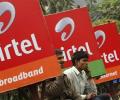
Bharti may look at gaining market share pre-merger and benefit from a lower capex intensity

From the Sensex basket, Kotak Mahindra Bank, HCL Technologies, ICICI Bank, Infosys, Tata Consultancy Services, Wipro, Tech Mahindra and Larsen & Toubro were the major laggards. Mahindra & Mahindra, Nestle, Tata Motors and IndusInd Bank were among the gainers.

'We suggest an equity strategy of 5% to 10% exposure to cash, 5% to Gold ETF, close to 50% to Sensex/Nifty/large mid-cap stocks.'

Sandwiched between demonetisation, GST and other smaller policy changes, Gross Value Added or GVA may be a more reliable measure of economic activity over the next few quarters.

While markets are watching the rupee touch record lows, Paul Mackel, Head of Asia Currency Research-Global Research at HSBC, says the currency is not yet in a free fall.

Domestic airlines expect the fall in prices of aviation fuel to boost their earnings from the quarter ending December.

One of the reasons is the increasing number of upgrades in analysts' recommendations.
.jpg)
Bank has cited trend of global easing and weak growth

The muted CPI inflation print at 5% earlier this week, followed by a similar WPI number released Wednesday, seems to have spurred India's central bank into action, is how the economists are reading into Reserve Bank of India governor Raghuram Rajan's 25 basis point cut in repo rate.

'Experts are not ruling out further pain as global factors cannot insulate India from the aftermath.'

Good performances by most information technology (IT) companies in the September quarter and improved forecasts notwithstanding, with the exception of Infosys, stocks of IT biggies such as TCS, Wipro and HCL Technologies have fallen three to nine per cent since Infosys announced its earnings on October 11.

Contract does not provide for retrospective penalty for 'such' acts

It, however, remains to be seen how much money Softbank actually puts in, what the implied equity valuation is and if the e-commerce venture is included in the Jio entity.
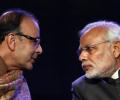
The Budget loosened the reins on public spending to drive growth.

The task force will look at emerging markets, technology, regulatory and monetary policies, loss of trust in financial services, and financial inclusion.

'Just the amount of work which is there just to become more and more successful in banking. For this to happen you need to have leaders who understand technology.'

So which sectors are likely to do well in 2022? Should you focus on domestic economy-related sectors or export-oriented ones?
The HSBC global research team has compared average annual fees and annual cost of living in 13 major study abroad destinations.

But splitting management bandwidth by investing in non-core businesses will not be appreciated by the market in the long run.

Technically, the Indian economy is on road to recovery.

Indian equity markets had a good run in the first half of calendar year 2023 (CY23), with the S&P BSE Sensex and the National Stock Exchange Nifty50 hitting fresh 52-week highs. While the Sensex scaled up to a peak 64,718, the Nifty50 hit Mt 19,189. As the markets now prepare to enter the second half (H2) of CY23, all eyes are on global central banks, especially the US Federal Reserve, as to when they will pause and pivot as regards their interest-rate cycle.
However, some experts also feel that there is a case for front-loading of interest rate cut to give a push to the economy

Airline says can't discuss dues publicly, denies grounding of planes

India is likely to see over 100 mature, large-scale profitable or on the path to profitability startups in the next five years, of which 80 have the potential to go for public listing, market research and consultancy firm Redseer said on Tuesday. Redseer Strategy Consultants, in a report on IPOs, said 20 of the mature startups have gone public so far. "India may see over 100 matured, large-scale profitable/path-to-profitability start-ups in the next five years.

Indian frontline benchmarks - the S&P BSE Sensex and the Nifty50 - have rallied around 12 per cent each since June-end and outperformed their global peers by a wide margin. On Thursday, the US Fed hiked interest rates by another 75 basis points (bps) - the third such hike this year - and surprised the markets by projecting further sizable hikes in the coming months. With the latest hike, the Fed fund rate (FFR) now stands in the range of 3 - 3.25 per cent and is highest since January 2008.

History would indicate that a recession is not that far off.
Exports of high-tech products will grow more quickly than exports of other goods over the next 15 years as emerging Asia moves away from being a low-cost production hub for foreign brands and toward developing value-added local products, according to research from HSBC.

Most analysts expect the note ban to sharply hit GVA growth in Q3 and Q4, and the central bank's stance is being called into question.

Markets

With future prospects being difficult to predict, hiring for a short period is proving to be cost-effective

A slew of Indian firms, including Flipkart, Byju's and Zomato, is building a path to profitability and diversifying into newer business segments ahead of mega-IPO plans.

After a stellar November that saw companies mop up over Rs 36,000 crore from the primary market via initial public offers (IPOs) and offers for sale (OFS), the current month, analysts said, will test investor's willingness to stay on with their investments as the one-month mandatory lock-in period for anchor investors begins to loosen. A note by Edelweiss Alternative Research suggests that in calendar year 2021 (CY21), 51 companies went public. Of these, 41 issuances' anchor selling dates are already over.

Notwithstanding expectations of a pick-up in construction activity during a seasonally strong January-March quarter (fourth quarter) of 2022-23 (FY23), analysts are cautiously optimistic about the building material sector - encompassing paints, pipes, wood panels, tiles, metals, and cement - as volatile input costs, coupled with fears of a global slowdown, are making demand projections uncertain. Against this backdrop, analysts suggest investors stay selective and pick stocks of companies with stronger brand recall, expanding distribution network, diversified product profile, healthier balance sheet, and sustainable cash flow. "The government's various proposals under Budget 2023-24 (FY24) may lead to the building material segment growing between 8 per cent and 12 per cent for the next five years.
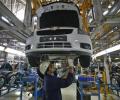
The pace of economic growth in emerging markets continued to revive from the stagnation seen earlier in the year.
